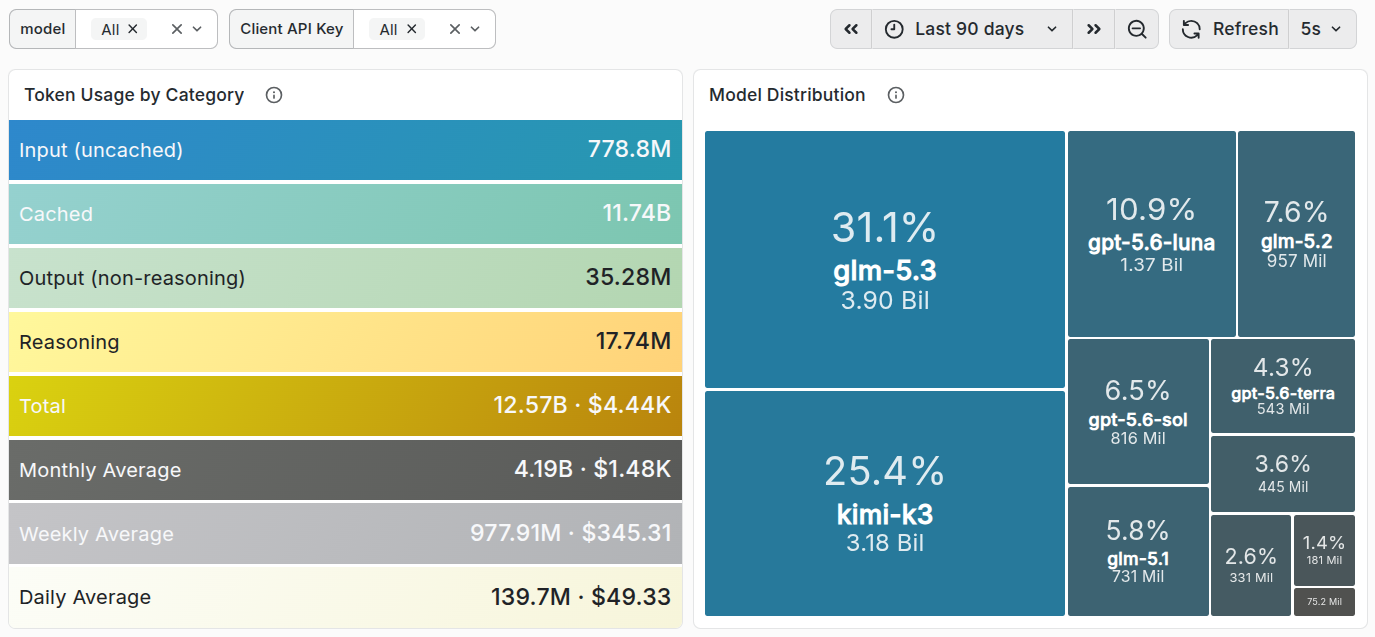
WORKSPACE-GATEWAY relays shared LLM traffic through Apache APISIX with per-tenant virtual keys, spend limits, and PII redaction. It speaks each provider's native protocol, with usage, cost, and health tracked in ClickHouse and Grafana; this repo ships sample routes to OpenCode Go and Zen, Kimi, Z.ai, Anthropic, OpenAI, Alibaba Token Plan, and a local llamafile.
# 1. Install podman-compose and build images
make install

# 2. Start the gateway stack (APISIX + etcd + ClickHouse + Vector + OpenBao + Prometheus + Grafana)
make gw-start

# 3. Send a request through the gateway
KEY="$GATEWAY_API_KEY"  # vgw-gateway-key from .env (provisioned in OpenBao on start)
curl -s http://localhost:9080/opencode_federated/v1/chat/completions \
  -H "Authorization: Bearer $KEY" \
  -H "Content-Type: application/json" \
  -d '{"model":"minimax-m3","messages":[{"role":"user","content":"Say hello"}]}'
Host port surface:
| Service | Dev | Prod | Exposure |
|---|---|---|---|
| APISIX HTTP / HTTPS | 9080 / 9443 | 9081 / 9444 | public |
| ClickHouse HTTP | 8123 | 8124 | loopback, authenticated |
| Grafana | 3030 | 3030 | loopback, edge-proxy auth |
etcd, OpenBao, Vector, Prometheus, the APISIX Admin API and metrics, and the
ClickHouse native port publish no host ports; reach them with podman exec.
curl, jq, openssl, xxd (used by tests and key scripts)uv (for .venv setup).env file with ADMIN_KEY, OPENCODE_API_KEY, GATEWAY_API_KEY,
OPENBAO_TOKEN, GRAFANA_ADMIN_PASSWORD, the ClickHouse credential set,
and the etcd credential set (see .env.example, gitignored)Run make init to check all system dependencies and print install
instructions for any that are missing.
Legend (all diagrams in this doc): solid arrows = request/response data path; dashed arrows = config, key lookup, or read-only observability.
flowchart TB
    Clients[Clients]
    Gateway["LLM Gateway<br/>APISIX :9080"]
    Cloud["Cloud LLM APIs<br/>OpenAI · Anthropic · xAI · ..."]
    Local["Local inference<br/>llamafile · vLLM · ..."]
    OpenBao[(OpenBao)]
    Store[(ClickHouse)]

    Clients -->|HTTPS| Gateway
    Gateway -->|cloud relays| Cloud
    Gateway -->|local relay| Local
    Gateway -.->|vgw-* keys| OpenBao
    Gateway -.->|usage and request logs| Store
Clients hit APISIX, which relays to cloud or local LLM APIs, resolves virtual keys via OpenBao, and persists usage data. Deeper flows are diagrammed in the section that owns each concern: Plugins (request path), Configuration (telemetry, metrics, route config), Key Management (auth).
All 18 relay routes as registered in APISIX (definitions in
conf/apisix.yaml, provider config in
conf/providers/):
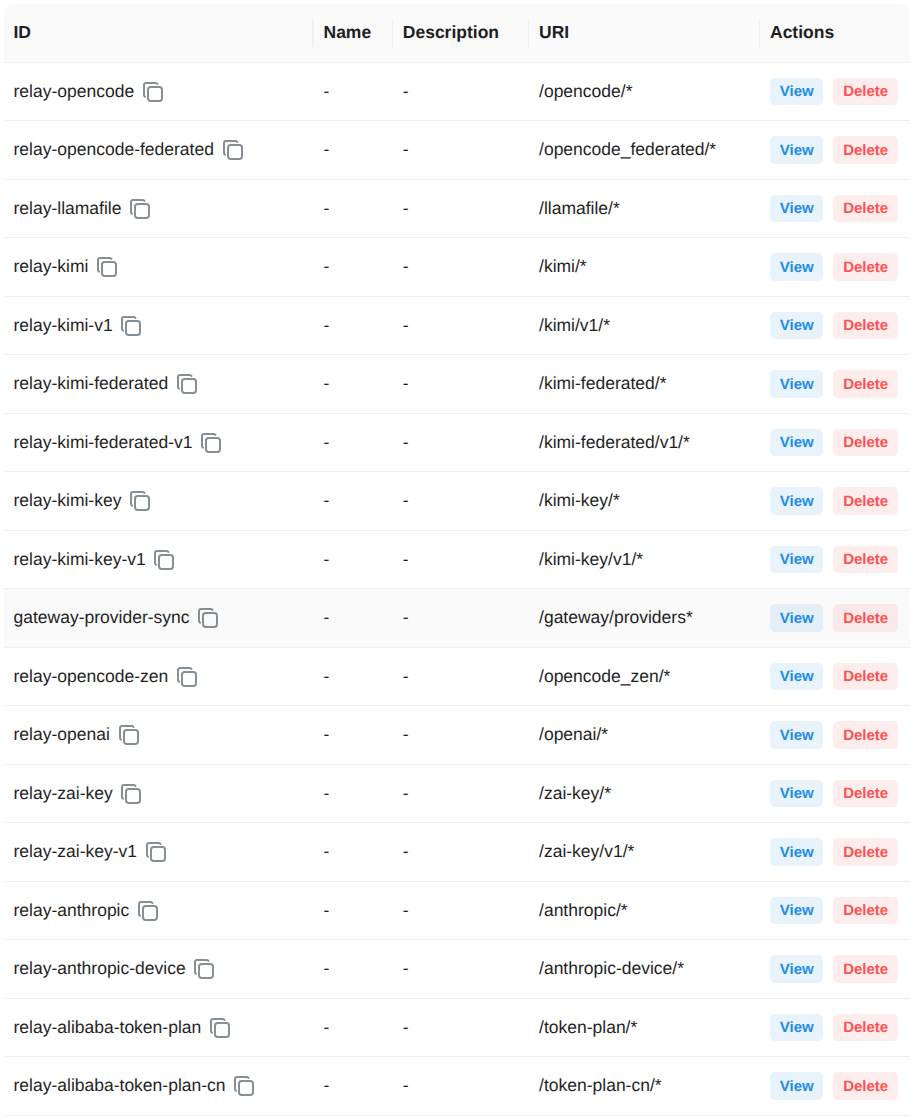
In this sample, OpenCode Go exposes 20+ models (MiniMax, Kimi, GLM,
DeepSeek, Qwen, MiMo, HY3) and OpenCode Zen serves the free/Zen model set
(*-free + pay-as-you-go) via the /opencode_zen/* relay. Swap the
upstream node in apisix.yaml.j2 to point at any other compatible API.
Upstream API-key quota exhaustion is handled by upstream key pools (see
Key Management).
upstream + proxy-rewrite; ai-proxy deliberately absent (Config).redact, regex + dictionary + Luhn, pure Lua (Custom).key-resolver, OpenBao KVv2 (persistent file-storage) with a shared dict cache (Custom).key-resolver, non-vgw- keys forwarded as-is (Custom).key-resolver + upstream_pool_lib.lua, sticky selection with auto-rotate on 429/402/403 (Custom).provider-oauth + oauth_device / oauth_jwt / oauth_store, protocol engines with per-route config, OpenBao session storage, and transparent refresh (Custom).sse-usage, buffers SSE, extracts usage, writes ClickHouse (Custom).limit-count + key-meta (Built-in + custom Lua).key-resolver + sse-usage + ngx.shared (Custom Lua).http-logger to Vector to ClickHouse (Built-in).prometheus at :9100 (Built-in).proxy-buffering disabled per-route (Config).Decimal64(6), tiered retention (archive volume, no deletion), LowCardinality keys (SQL).Status: WIP. Target: APISIX plugins on the federated request path that score
assistant behavior and enforce moderation policy before or after upstream relay,
alongside existing redact and key-resolver policy plugins.
Status: WIP. A semantic-cache plugin (pgvector-backed response reuse) is
not attached to any route; it needs a pgvector store added to the stack.
flowchart TB
    Client[Client]
    Route["/opencode_federated/*"]
    Policy[Policy plugins]
    Proxy[Proxy plugins]
    Upstream[Cloud upstream]
    OpenBao[(OpenBao)]

    Client --> Route --> Policy --> Proxy --> Upstream
    OpenBao -.->|key lookup| Policy
Policy = key-resolver, key-meta, redact, limit-count (access phase).
Proxy = proxy-rewrite, upstream proxy, proxy-buffering. Telemetry plugins
run after the upstream responds; see ClickHouse Tables.
/opencode/* skips key-resolver; /llamafile/* skips auth and targets a
local upstream (see sample deployments).
Plugins on the request path, in Nginx phase-priority order (provider-oauth
replaces key-resolver on the kimi routes):
proxy-rewrite (N/A, Built-in, rewrite) : Strips route prefix; opencode relays → /zen/go/*, opencode zen relay → /zen/*, llamafile → upstream rootprovider-oauth (2560, Custom Lua, access, kimi routes) : Upstream device/browser OAuth with transparent token refreshkey-resolver (2555, Custom Lua, access, federated only) : Resolve vgw-* keys via OpenBao; pass through otherskey-meta (2530, Custom Lua, access) : Compute key hash for per-key scoping (X-Key-Hash)redact (2500, Custom Lua, access/header_filter/body_filter/log) : PII anonymization + re-hydrationsse-usage (2400, Custom Lua, header_filter/body_filter/log) : Extract token usage; increment budget counterlimit-count (2002, Built-in, access) : Per-key RPM; federated route uses variable limits from OpenBao headersrequest-id (N/A, Built-in, rewrite/log) : Add X-Request-Id and echo it in the responsehttp-logger (410, Built-in, log) : Send req/resp metadata to Vectorproxy-buffering (300, Built-in, filter) : Disable buffering for SSEprometheus (N/A, Built-in, log) : Export metrics at :9100Each custom plugin is split into two files:
*_lib.lua : Pure logic module, requireable, unit-testable (deps: cjson, ngx.re only)*.lua : APISIX adapter: lifecycle phases, ctx, shared dict (deps: Full APISIX API)flowchart TB
REQ["Authorization: Bearer token"] --> CHECK{"Starts with vgw-?"}
CHECK -->|"YES"| OPENBAO["Lookup in OpenBao"]
OPENBAO -->|"Found + active"| INJECT["Inject upstream provider key"]
OPENBAO -->|"Not found"| R401["401 invalid key"]
OPENBAO -->|"Revoked"| R401R["401 key revoked"]
OPENBAO -->|"Unreachable"| R503["503 key store unreachable"]
CHECK -->|"NO"| PASS["Pass through provider key"]
INJECT -->|"federated route"| UPSTREAM["Configured upstream provider"]
PASS -->|"passthrough route"| UPSTREAM
Applies to /opencode/* and /opencode_federated/* only; /llamafile/*
has no Authorization flow.
Virtual keys (vgw-*): used on relay-opencode-federated,
relay-kimi-federated, and relay-kimi-federated-v1. Stored in OpenBao
KV v2 and resolved at request time to an upstream provider key. Revocable,
rate-limited per tenant, audited. Cached in the key_cache shared dict
(5s TTL in dev, 300s in prod).
Direct keys (any non-vgw- prefix, e.g. sk-*): used on the
/opencode/*, /kimi-key/*, and /zai-key/* routes. Passed through to
upstream as-is. No OpenBao lookup. Users bring their own provider API keys.
Upstream key pools: named sets of upstream API keys shared by one or
more virtual keys. key-resolver selects pool keys sticky-style and rotates
on upstream quota/rate-limit responses (429 parks a key in cooldown, 402/403
hard-disables it in OpenBao).
Mapping precedence at request time: a non-empty upstream_pool wins, then the
key's own upstream_key, then the gateway-wide OPENCODE_API_KEY.
Every key operation goes through one dispatcher, make key ARGS='...'
(wrapper: res/scripts/gateway-key.sh). The
older single-purpose targets (make issue-key, make list-keys,
make revoke-key, make pool-key) remain, but they expose fewer flags:
issue rate-limit and budget options are reachable only through make key
or the script directly.
make key ARGS='issue'                                    # vgw-<random hex>, defaults
make key ARGS='issue --key-id vgw-acme-01 --tenant acme --user alice'
make key ARGS='issue --key-id vgw-acme-01 --pool kimi'   # attach an upstream pool
make key ARGS='issue --key-id vgw-acme-01 --upstream-key sk-...'
make key ARGS='issue --key-id vgw-acme-01 --rate-limit-rpm 100 --token-budget 5000000'
make key ARGS='list'                                     # KEY_ID / TENANT / USER / ACTIVE / CREATED
make key ARGS='show vgw-acme-01'                         # record plus its upstream mapping
make key ARGS='map vgw-acme-01 --pool kimi'              # set or change the mapping
make key ARGS='map vgw-acme-01 --upstream-key sk-...'
make key ARGS='map vgw-acme-01 --none'                   # clear (use gateway OPENCODE_API_KEY)
make key ARGS='revoke vgw-acme-01'                       # active=false, record kept
make key ARGS='pool list'
make key ARGS='pool create kimi'
make key ARGS='pool add kimi k1 sk-...'
make key ARGS='pool remove kimi k1'
make key ARGS='pool disable kimi k1'
make key ARGS='pool enable kimi k1'
make key ARGS='pool reset kimi'
Run make key ARGS='help' for the full flag list. The scripts call the OpenBao
KV v2 HTTP API directly (not APISIX or etcd) through podman exec gw-openbao,
because OpenBao publishes no host port. Writes carry the shared OPENBAO_TOKEN,
so they are not attributed to an individual operator.
flowchart TB
    J2[apisix.yaml.j2]
    YAML[apisix.yaml]
    Seed[seed-routes.sh]
    Etcd[(etcd)]
    Routes[APISIX routes]
    Admin["Admin API :9180"]

    J2 --> YAML --> Seed --> Etcd --> Routes
    Admin -.->|route CRUD| Etcd
Traditional/etcd mode (RBAC-enabled; APISIX authenticates as a dedicated
etcd user): routes live in etcd, seeded from the rendered conf/apisix.yaml
on stack start. Admin API and built-in dashboard are reached via
podman exec gw-apisix curl http://127.0.0.1:9180/ui/ (no host port).
conf/config.yaml: APISIX traditional/etcd mode: plugin list, shared dicts, env vars, Admin API, Prometheus portconf/apisix.yaml: Committed route render (18 routes); drift-checked against conf/apisix.yaml.j2conf/apisix.yaml.j2: Jinja2 route template rendered at deploy from .envres/scripts/seed-routes.sh: Seeds etcd from rendered apisix.yaml on stack startconf/openbao.hcl: OpenBao production config (file-storage backend)conf/prometheus.yml: Prometheus scrape config (APISIX :9100)conf/profanity/: vendored rejection-language dictionaries (refresh: make gw-update-dictionaries)conf/grafana/: Grafana datasources + 5 provisioned dashboardsconf/redact-patterns.json: PII detection: 6 regex patterns + 2 dictionary categoriesconf/sql/: All SQL (no inline SQL anywhere). clickhouse-init.sql base schema, migrations/ incremental changes, plus ops/, ingest/, grafana/queries/, sqlite/, tests/. Templates rendered by res/scripts/lib-sql.sh and linted by sqlfluff via .sqlfluffconf/vector.toml: Vector pipeline: HTTP source, VRL remap (parse_json for model extraction), ClickHouse sinkres/docker/docker-compose.yml: 8 services: apisix, etcd, clickhouse, migrate, vector, openbao, prometheus, grafanares/docker/Dockerfile.apisix: Custom APISIX image: Lua plugins + config copied inres/docker/Dockerfile.openbao: Custom OpenBao image (production file-storage)res/docker/openbao-entrypoint.sh: OpenBao auto-init, auto-unseal, gateway key provisioning (data persists via openbao-data named volume).env: Secrets: ADMIN_KEY, OPENCODE_API_KEY, GATEWAY_API_KEY, OPENBAO_TOKEN| Variable | Purpose | Example |
|---|---|---|
ADMIN_KEY |
APISIX Admin API key (not stored in tracked files) | your-apisix-admin-key |
OPENCODE_API_KEY |
Upstream Go key (injected into proxied requests) | sk-HiEr... |
OPENCODE_BASE_URL |
Upstream Go base URL | https://opencode.ai/zen/go/v1 |
OPENCODE_ZEN_BASE_URL |
Upstream Zen/free base URL | https://opencode.ai/zen/v1 |
GATEWAY_API_KEY |
Default virtual key for opencode integration | vgw-gateway-key |
OPENBAO_TOKEN |
Root token for OpenBao KVv2 API | 2e22c6e... |
CONTEXT_LIMIT_PCT |
Context limit scaling percentage | 80 |
CONTEXT_LIMIT_CEILING |
Absolute max context tokens after scaling | 128000 |
GRAFANA_ADMIN_PASSWORD |
Grafana admin login (strong value; never admin) |
(openssl rand) |
GRAFANA_EDGE_CIDR |
Sources Grafana trusts X-WEBAUTH-USER from |
10.99.10.1/32,127.0.0.1/32 |
CLICKHOUSE_PASSWORD |
ClickHouse default user (localhost-only) |
(openssl rand) |
CH_GRAFANA_RO_PASSWORD |
Grafana datasource account (grafana_ro, readonly) |
(openssl rand) |
CH_VECTOR_PASSWORD |
Vector sink account (vector_rw, insert-only) |
(openssl rand) |
CH_APISIX_PASSWORD |
sse-usage account (apisix_rw, insert-only) |
(openssl rand) |
CH_MIGRATOR_PASSWORD |
golang-migrate account (migrator, DDL) |
(openssl rand) |
CH_OPS_PASSWORD |
Operator account (ops_admin, full access; guard like root) |
(openssl rand) |
ETCD_ROOT_PASSWORD |
etcd bootstrap root credential | (openssl rand) |
ETCD_GW_USER / ETCD_GW_PASSWORD |
APISIX → etcd non-root credential | apisix / (openssl rand) |
Telemetry runs in response/log phases after the upstream returns:
flowchart TB
    Response[Upstream response]
    Tele[Telemetry plugins]
    CH[(ClickHouse)]
    Vector[Vector]

    Response --> Tele
    Tele -->|usage_log| CH
    Tele -->|request_log| Vector
    Vector --> CH
sse-usage writes usage_log directly (as apisix_rw); http-logger
ships full request/response metadata to Vector, which inserts request_log
(metadata) and request_bodies (bodies; req_body is PII-tokenized by the
redact plugin before logging, and is invisible to the Grafana datasource).
| Table | Written By | Key Columns |
|---|---|---|
request_log |
Vector (from http-logger) | request_id, model, status, identity columns (no bodies) |
request_bodies |
Vector (from http-logger) | event_id, request_id, req_body, resp_body (ops_admin-only) |
usage_log |
sse-usage plugin (via timer) | request_id, model, token breakdown, cost, cost_source |
billing_ledger |
MV on usage_log INSERT |
cost Decimal64(6), rate_input/output, cache_status |
billing_discrepancies |
v2 reconciler (deferred) | gateway_tokens, provider_tokens, divergence |
Retention moves old parts to a tiered, ZSTD-recompressed archive volume rather
than deleting them.
The ops-health storage panel monitors growth, and nightly backups land on
/mnt/ws-backup.
flowchart TB
    Plugin[prometheus plugin]
    Export["APISIX :9100"]
    Prom[(Prometheus)]
    Grafana[Grafana]
    CH[(ClickHouse)]

    Plugin --> Export
    Prom -.->|scrape| Export
    Grafana -.->|PromQL| Prom
    Grafana -.->|SQL queries| CH
The prometheus plugin exports request metrics at :9100. Prometheus
scrapes every 15s (conf/prometheus.yml). Grafana uses Prometheus for
ops panels (latency, error rate) and ClickHouse for cost and usage.
Grafana only queries data; it does not write.
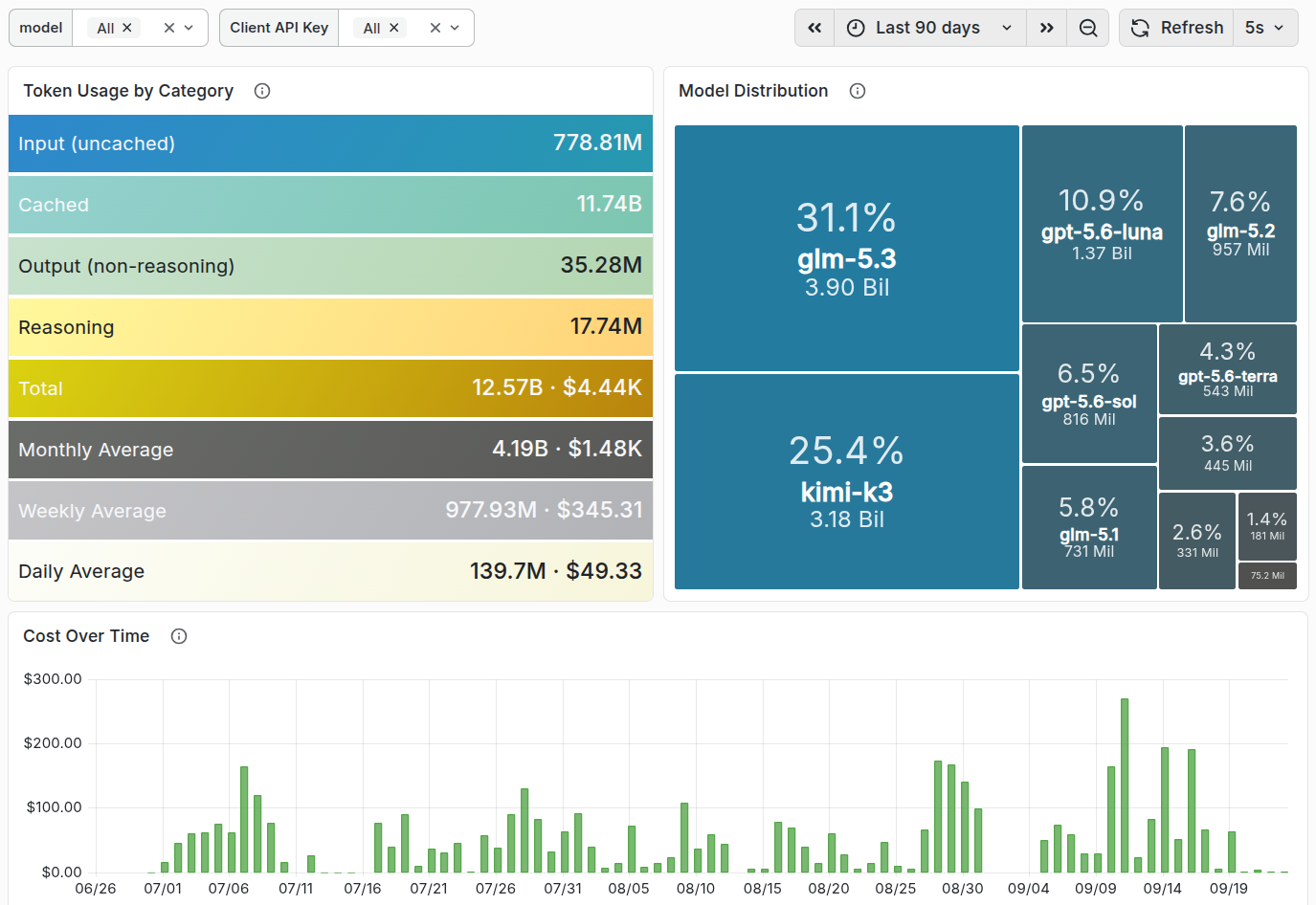
Five provisioned dashboards (default: now-90d lookback, 5s refresh):
| Dashboard | URL |
|---|---|
| Gateway Cost & Usage | http://localhost:3030/d/gateway-cost-usage?from=now-90d&to=now&refresh=5s |
| Gateway Operations & Health | http://localhost:3030/d/gateway-ops-health?from=now-90d&to=now&refresh=5s |
| Gateway Cost Leaderboard | http://localhost:3030/d/gateway-cost-leaderboard?from=now-90d&to=now&refresh=5s |
| Gateway Model Experience | http://localhost:3030/d/gateway-model-experience?from=now-90d&to=now&refresh=5s |
| Gateway Model Performance | http://localhost:3030/d/gateway-model-performance?from=now-90d&to=now&refresh=5s |
Cost & Usage breaks spend down by token category and model:
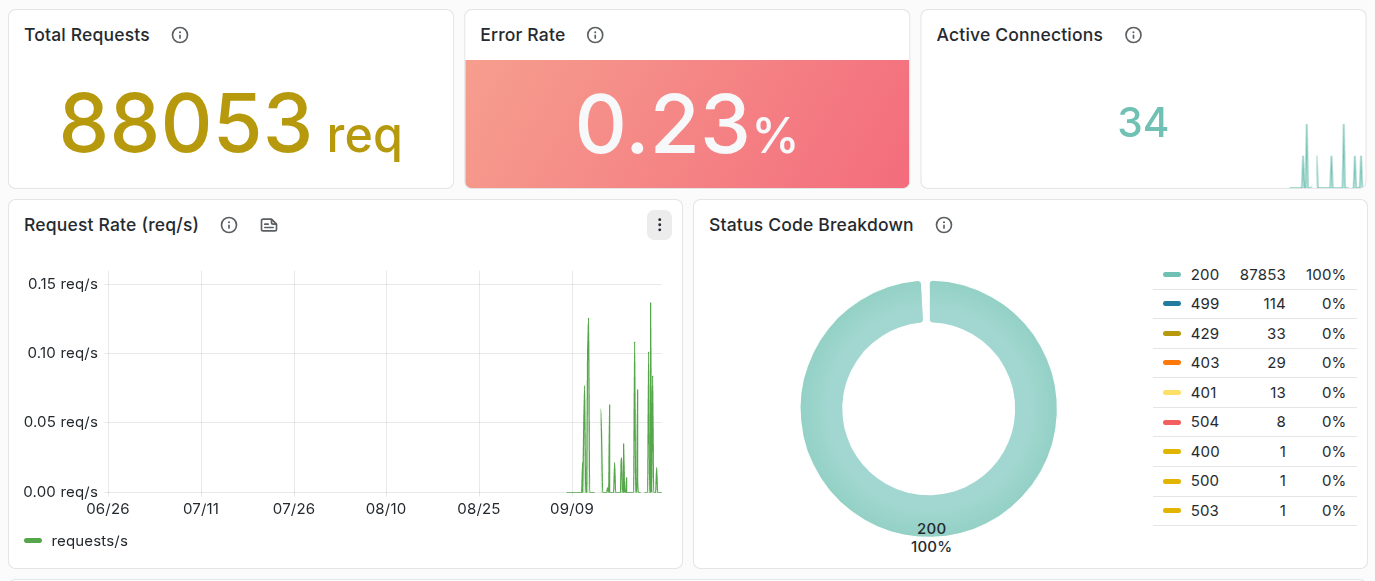
Operations & Health covers live traffic, error rate, and status codes:
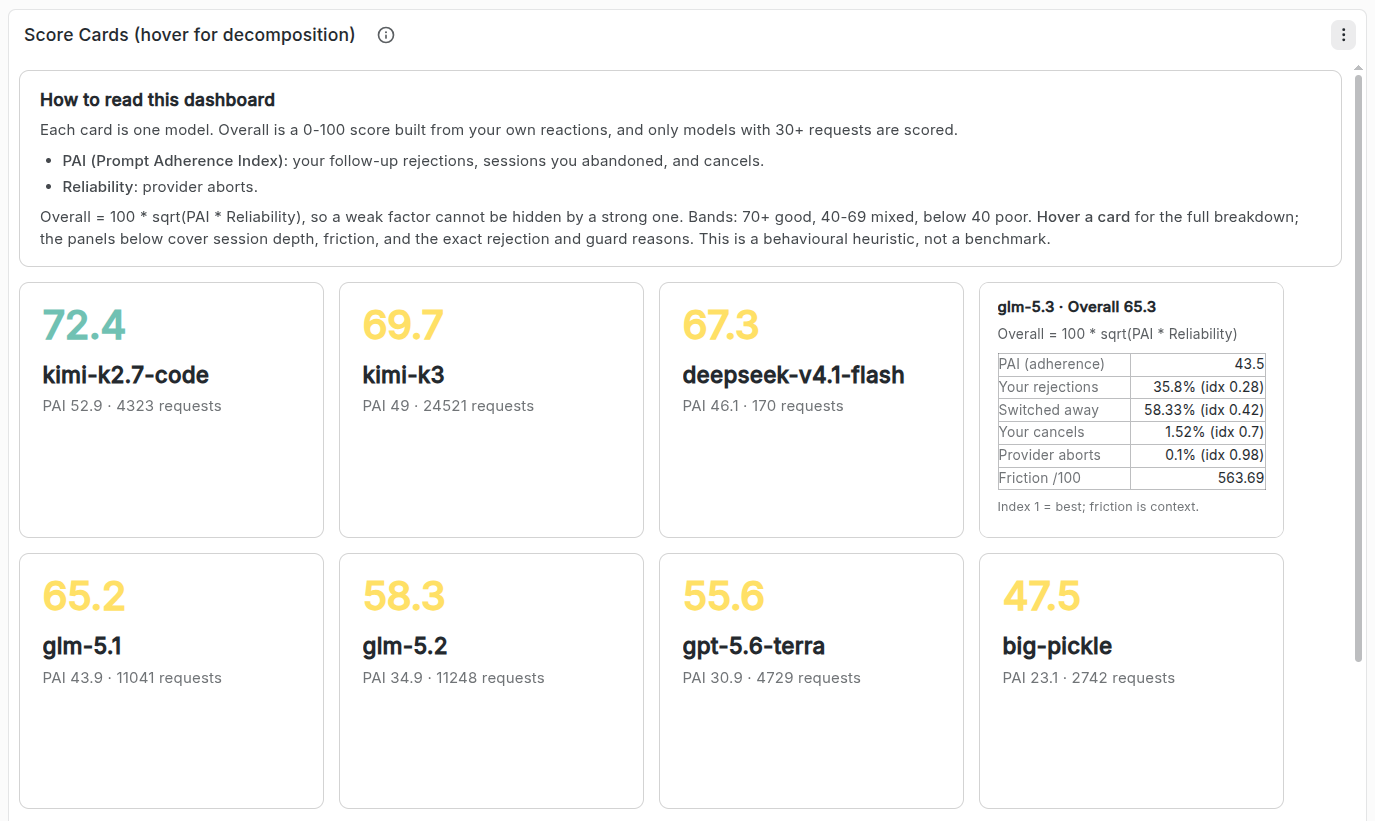
Model Experience ranks each model by a behavioural usefulness score built from satisfaction, friction, and abandonment signals:
Model Performance tracks speed, stream reliability, and time to first token:
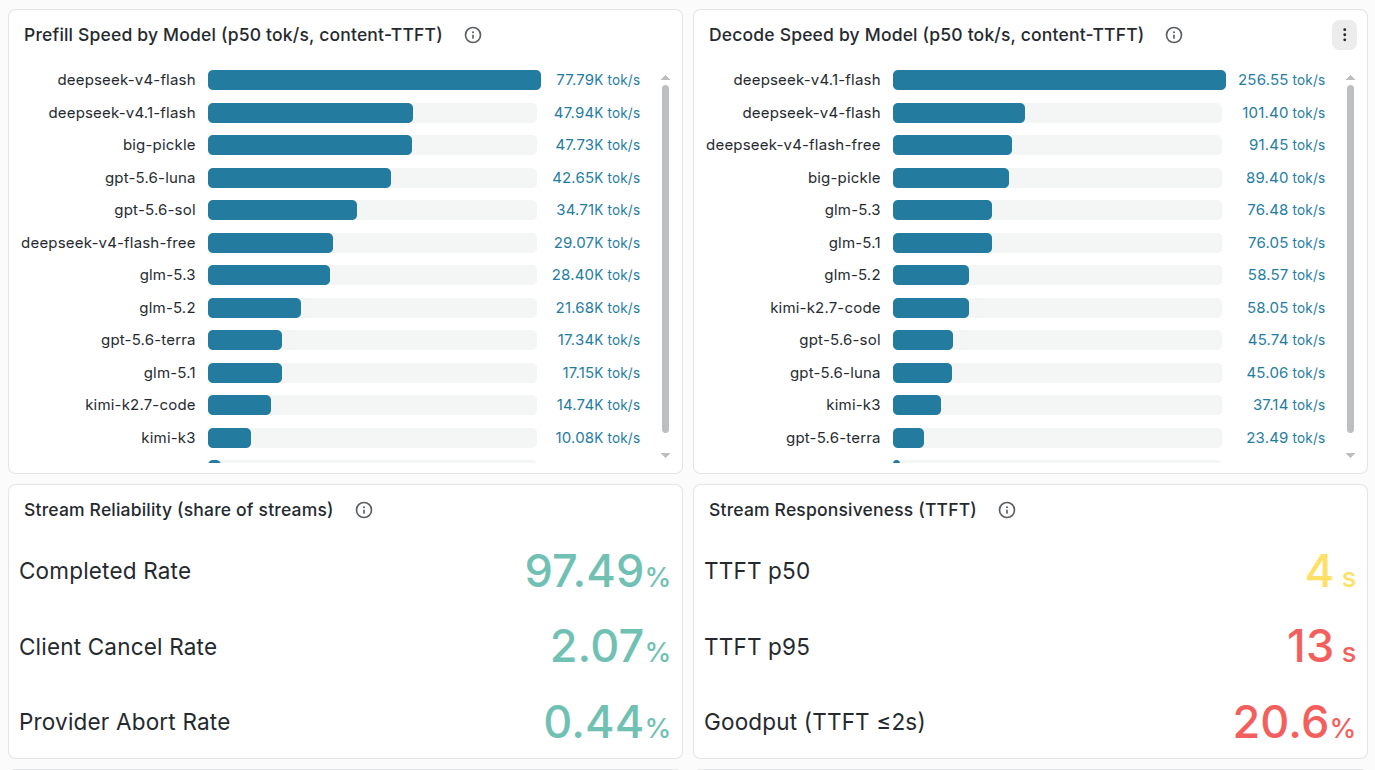
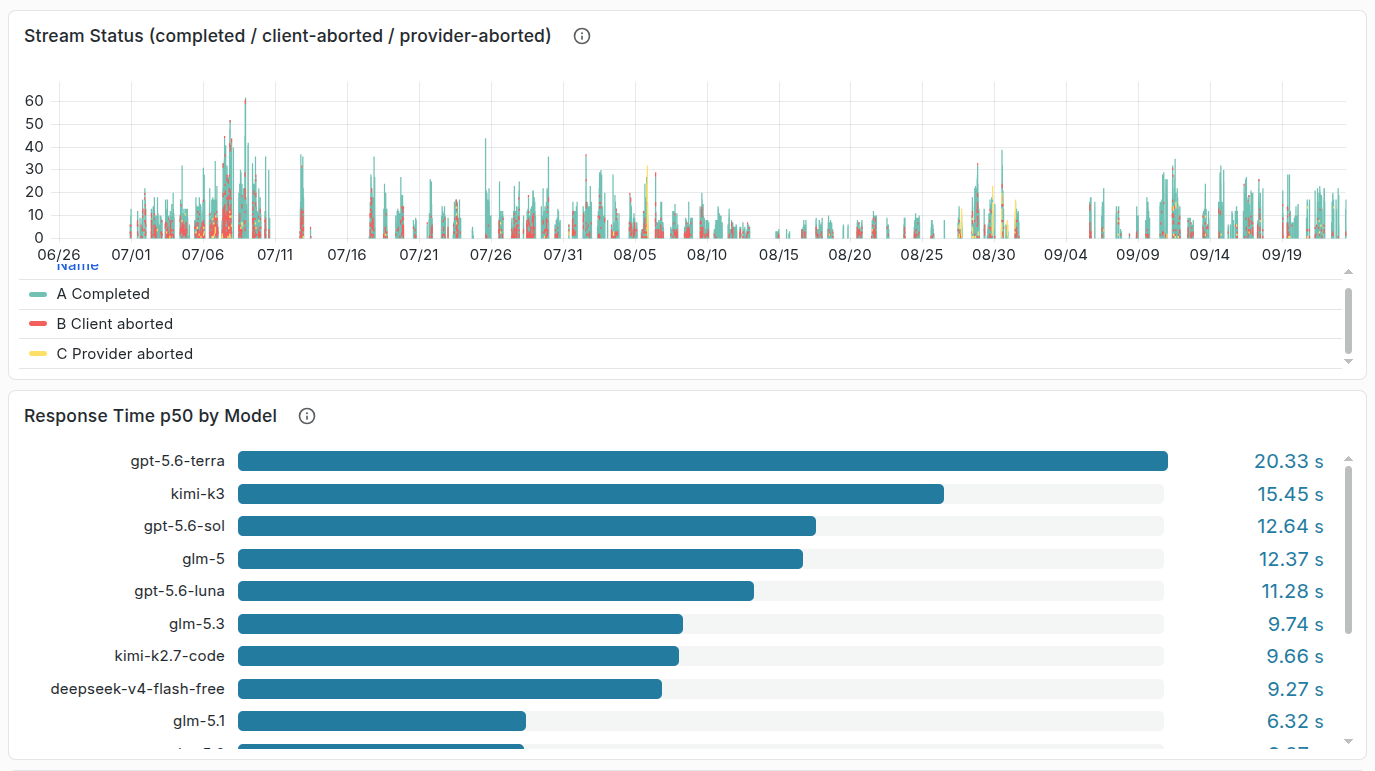
The leaderboard shows top clients (p20) and top models (p21) by cost and
tokens. After editing dashboard JSON, run make gw-restart-grafana to
reload provisioning.
The gateway registers canonical auth-mode providers: OpenCode Go virtual/API key, OpenCode Zen API key, llamafile no-auth, three Moonshot Kimi modes (device OAuth, virtual key, and API key), and Z.ai GLM API-key passthrough as custom providers in opencode.
# Refresh the gateway-side provider/model catalog (does NOT touch client config)
make sync-models

# Install ALL gateway providers into opencode config (auth skipped by default)
make setup-providers

# Same, prompting for API keys / running OAuth device flows:
make setup-providers REQUIRE_AUTH=1

# Add a key for one provider later:
bash res/scripts/opencode-provider-login.sh --provider-id workspace-gw-zai-api-key --require-auth
This enriches the gateway catalog from /opencode_federated/v1/models (Go
tier, *-free models filtered out), /opencode_zen/v1/models (all Zen/free
models), and /llamafile/v1/models (local llamafile upstream), with canonical
metadata (name, context limit, capabilities, cost, modalities) from
models.dev, including variants (reasoning-effort
presets) derived from models.dev reasoning options exactly as opencode derives
them.
Provider entries are written into ~/.config/opencode/opencode.jsonc by the
login script above, which fetches each ready-made block from
/gateway/providers/<id>/opencode:
workspace-gw-opencode-go-virtual-key: virtual-key mode, Go tierworkspace-gw-opencode-go-api-key: API-key passthrough, Go tierworkspace-gw-opencode-zen-api-key: API-key passthrough, free/Zen modelsworkspace-gw-llamafile-no-auth: no-auth local LLMworkspace-gw-kimi-device-oauth: device OAuth (gateway-managed Kimi token)workspace-gw-kimi-virtual-key: virtual-key mode for Kimi (vgw-*)workspace-gw-kimi-api-key: API-key passthrough for Kimiworkspace-gw-zai-api-key: API-key passthrough for Z.ai GLM (Coding Plan endpoint)workspace-gw-anthropic-passthrough: API-key passthrough for Anthropicworkspace-gw-anthropic-device-oauth: device OAuth for Anthropicworkspace-gw-openai-device-oauth: device OAuth for OpenAI (ChatGPT)workspace-gw-alibaba-token-plan-passthrough: API-key passthrough, Alibaba Token Planworkspace-gw-alibaba-token-plan-cn-passthrough: API-key passthrough, Alibaba Token Plan (China)For the OAuth providers, the login script starts the device flow and prints the verification URL.
Each provider receives the full enriched catalog, because opencode drops
providers that expose zero models. The two Go providers
(workspace-gw-opencode-go-virtual-key and workspace-gw-opencode-go-api-key)
filter out *-free models, since their relay rewrites to /zen/go/ (paid
only); free models are served only through
workspace-gw-opencode-zen-api-key. The llamafile provider takes its model
list from /llamafile/v1/models (or a default id when the server is down);
MiniCPM5 uses context 131072 (scaled to 104857 at 80%) with tool_call: true. The script runs automatically on make gw-start and make gw-restart
via the Ansible playbook.
Context limits are scaled by CONTEXT_LIMIT_PCT (default 80) from .env,
so e.g. CONTEXT_LIMIT_PCT=80 reduces a 200000-token context to 160000.
An absolute ceiling CONTEXT_LIMIT_CEILING (default 128000) is then
applied: any scaled value exceeding the ceiling is clamped to it. Set to
0 to disable.
Result in opencode config:
{
  "provider": {
    "workspace-gw-opencode-go-virtual-key": {
      "api": "http://localhost:9080/opencode_federated/v1",
      "npm": "@ai-sdk/openai-compatible",
      "options": {
        "baseURL": "http://localhost:9080/opencode_federated/v1",
        "apiKey": "vgw-gateway-key",
        "headers": { "X-Tenant-ID": "default", "X-User-ID": "agent" }
      },
      "models": {
        "minimax-m3": {
          "name": "MiniMax M3",
          "family": "minimax",
          "release_date": "2026-06-01",
          "attachment": true,
          "reasoning": true,
          "temperature": true,
          "tool_call": true,
          "cost": { "input": 15, "output": 75, "cache_read": 1.5, "cache_write": 18.75 },
          "limit": { "context": 160000, "output": 24000 },
          "modalities": { "input": ["text", "image", "pdf"], "output": ["text"] },
          "status": "active"
        }
      }
    },
    "workspace-gw-opencode-go-api-key": {
      "api": "http://localhost:9080/opencode/v1",
      "npm": "@ai-sdk/openai-compatible",
      "options": {
        "baseURL": "http://localhost:9080/opencode/v1",
        "headers": { "X-Tenant-ID": "default", "X-User-ID": "agent" }
      },
      "models": { "...": "same enriched models as workspace-gw-opencode-go-virtual-key" }
    }
  }
}
make test          # Run all stages (excludes live upstream API tests)
make test-live     # Run all stages including live upstream API tests
make gw-test       # Same as test, against the running stack
resty CLI inside the APISIX containerRUN_LIVE_API_TESTS=1)The stack is owned by the systemd user unit gateway-compose
(make gw-deploy installs it with linger). Start/stop/restart go through
systemctl so an unmanaged compose stack never fights the unit's
Restart=always.
| Target | Description |
|---|---|
make gw-build |
Build container images |
make gw-start |
Start stack via systemd, provision keys, health checks |
make gw-stop |
Stop stack via systemd (keep volumes) |
make gw-restart |
Restart the stack via systemd |
make gw-update |
Build images, redeploy changed services via systemd, reconcile, and verify |
make gw-reconcile |
Reconcile routes, schema, and provider catalog without restarting containers |
make gw-verify |
Health report: status + one request through the gateway |
make gw-status |
Show systemd unit + containers |
make gw-logs |
Tail container logs |
make gw-shell |
Exec into APISIX container |
make gw-test |
Run full test suite against the running stack |
make gw-restart-service SVC=name |
Restart one existing service without recreating it |
make gw-recreate-service SVC=name |
Recreate one service from the current compose |
make gw-restart-grafana |
Restart Grafana, reload provisioning, sync dashboard defaults |
make gw-deploy |
Install + enable gateway compose on boot (systemd user + linger) |
make gw-undeploy |
Disable + remove gateway compose systemd unit |
make gw-systemd-logs |
Tail gateway systemd unit logs |
make ch-migrate |
Apply pending ClickHouse schema migrations |
make ch-migrate-status |
Show ClickHouse migration version |
Notes: gw-restart force-recreates every container from the current compose
and does not preserve running containers or apply compose network changes
selectively. gw-recreate-service applies network and env changes and supports
grafana, clickhouse, vector, openbao, prometheus, and etcd.
| Target | Description |
|---|---|
make key ARGS='issue ...' |
Unified key CLI: issue, list, show, map, revoke, pool |
make key ARGS='show vgw-xxx' |
Show a key record and its upstream mapping |
make key ARGS='map vgw-xxx --pool kimi' |
Set or change a key's upstream mapping |
make issue-key |
Create new vgw-* key in OpenBao |
make issue-key KEY_ID=... POOL=... |
Create a key attached to an upstream key pool |
make list-keys |
List all keys with metadata |
make revoke-key KEY_ID=vgw-xxx |
Revoke a key |
make pool-key ARGS='list' |
List upstream key pools |
make pool-key ARGS='create kimi' |
Create a new upstream key pool |
make pool-key ARGS='add kimi k1 sk-...' |
Add a key to an upstream pool |
make sync-models |
Refresh gateway-side provider/model catalog |
make setup-providers |
Install all gateway providers into opencode config (REQUIRE_AUTH=1 to prompt for keys) |
| Target | Description |
|---|---|
make lint |
Shell syntax + YAML validation |
make type-check |
Lua syntax check via resty in Podman |
make test |
Run all test stages (excludes live upstream API) |
make test-live |
Run all stages including live upstream API tests |
make check |
lint + type-check + test |
make check-push |
check + E2E tests (if Go key set) |
make plugin-install |
Install the gateway OpenCode plugin's Bun deps (BUN= overridable) |
make plugin-type-check |
TypeScript check of the OpenCode plugin via Bun |
make plugin-test |
Run the OpenCode plugin's Bun test suite |